Saturday
20
September
20
September
Let me begin by welcoming our esteem readers to this weekly health interactive forum that intends to promote good health and prevent diseases. This column, shall on weekly basis, discuss diseases of public health importance in addition to answering your questions sent by way of text message and/or email. The address and identity of the questioner shall be published unless he or she wants to remain anonymous. It is my hope that readers will benefit from it and constructively advise us on areas of improvement.
Medically, viruses are acellular organisms whose genomes consist of nucleic acid, and which obligately replicate inside host cells using host metabolic machinery to form a virion that in turn proffer protection to the genome and enable transfer to other cells. . As simplified by Wikipedia ‘A virus is a small infectious agent that replicates only inside the living cells of other organisms.” A virus has the ability to infect not only humans, but animals, plants and even other known infectious organisms such as bacteria.
The Ebola Virus derived its name from the Ebola River in the present Democratic Republic of Congo, This followed the first ever recorded simultaneous outbreaks, in Nzara, Sudan, and in Yambuku, Democratic Republic of Congo. Ebola Virus Disease (EVD) has traditionally remained contained in Central and West African countries notably Congo. Gabon,Cote d’Ivoire, etc. Ebolavirus comprises 5 distinct species:Bundibugyo ebolavirus (BDBV),Zaire ebolavirus (EBOV),Reston ebolavirus (RESTV),Sudan ebolavirus (SUDV) and Taï Forest ebolavirus (TAFV). All the species have been associated with EVD outbreak with the exception of RESTV and Tai Forest.
The World Health Organization (W.H.O) has so reported 358 cases of EVD across central, East and West African countries between the periods of 2003 to 2012 with a case fatality of 94%. The world is recording the worst outbreak that has claimed more than 1350 lives in some West African countries notably Liberia, Sierra leone and Guinea Conakry. The disease which was imported into Nigeria by the late Librarian Diplomat, Patrick Sowyer has so far claimed five Nigerian lives out of the fourteen officially confirmed cases. While we were celebrating the fact that the disease has been contained in Lagos with only one index case remaining, a Doctor has just lost his life in the City of Port Harcourt, south south Nigeria.
In Africa, fruit bats, particularly species of the genera Hypsignathus monstrosus, Epomops franqueti and Myonycteris torquata, are said to be the natural host of Ebola virus. Chimpanzee, monkeys gorillas and forest antelope are known reservoirs of the virus. Human contract the virus from their interaction with these animals body fluid or tissues and humam-human transmission results. Ebola spreads in the community through human-to-human transmission, with infection resulting from direct contact (through broken skin or mucous membranes) with the blood, secretions, organs or other bodily fluids of infected people, and indirect contact with environments contaminated with such fluids. People who come in direct contact with the dead body of an infected person can spread the disease. Seven weeks after recovery, the virus can still be transmitted sexually through the semen of infected men. Health-care workers who come in direct contact with suspected or confirmed EVD are vulnerable to contracting EVD.
The good news is that Ebola is not as contagious as more common viruses like colds, influenza, or measles.
The virus has an incubation period (symptom free period) of 2-21 days depending on the immune status of the victim. The symptoms the affected persons come up with are related to the ability of the virus to invade and damage the immune system and body organs. This eventually leads to drop in the concentration of platelets, which are blood-clotting cells. This leads to severe, uncontrollable bleeding. This informed the hither to name of the disease; Ebola haemorrhagic Fever.
The initial symptoms may be mistaken for common cold, malaria or typhoid fever leading to misdiagnosis. Established symptoms may include:
As the disease gets worse, it causes bleeding inside the body, as well as from the eyes, ears, and nose. Some people will vomit or cough up blood, have bloody diarrhea, and get a rash.
EVD definitive diagnosis is made in specialized laboratories from blood samples of infected persons. Samples from patients are an extreme bio-hazard risk; testing should be conducted under maximum biological containment conditions. The scientific community is yet to discover the definitive cure or vaccine the treatment for EVD, even though several animal trials are still been undertaken. Patients require supportive treatment to take care of their nutritional, oxygen, fluid and electrolyte requirements in isolated treatment camps like is happening in Lagos.
To effectively manage EVD,control measures must be put in place eliminate the reservoir and interrupt the chain of transmission in humans and domestic animals.
Control measures recommended by W.H.O and infectious disease experts include:
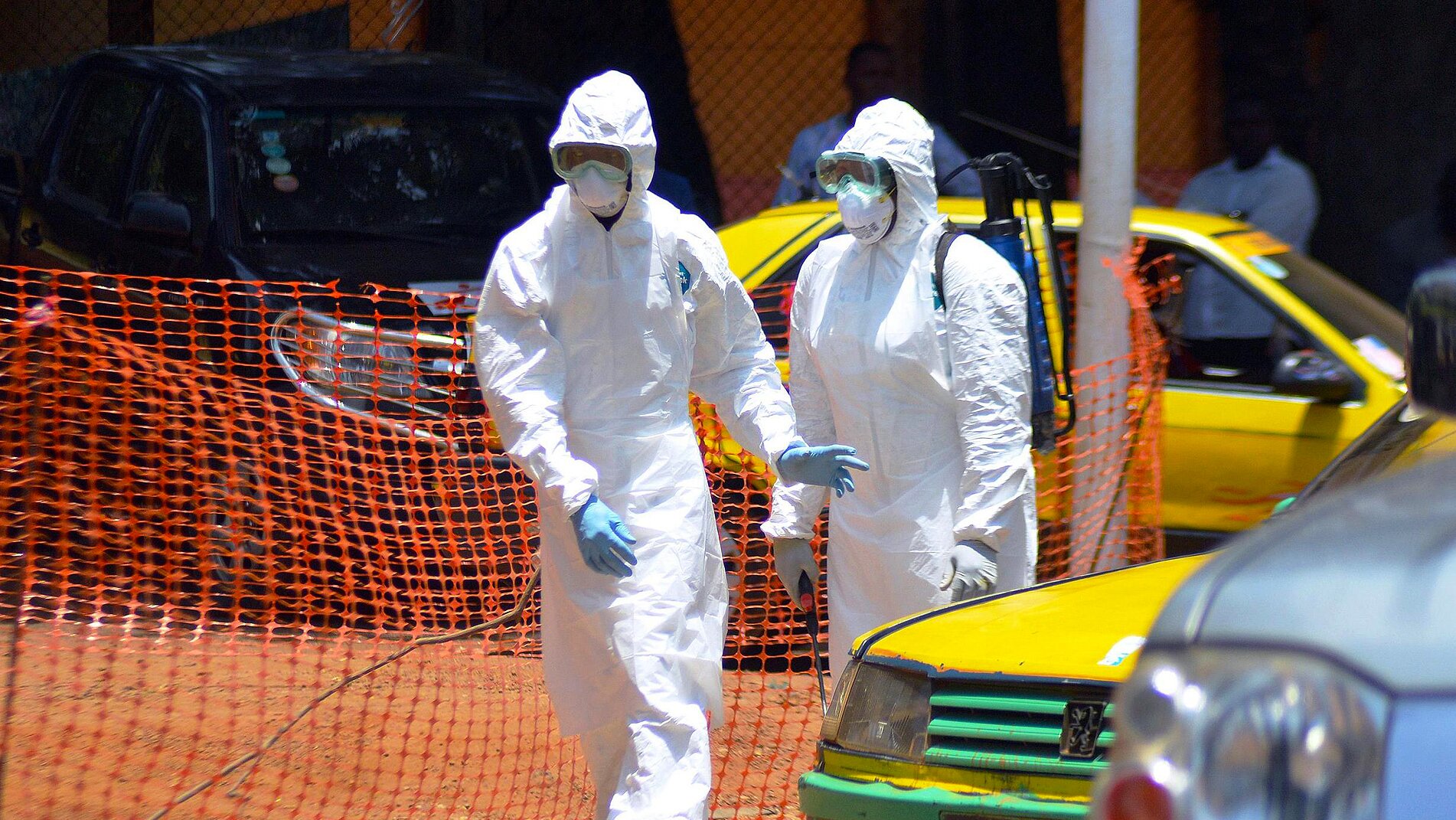
1. Close physical contact with the infected should be avoided or reduced as much as possible. Where this is not possible, gloves and other protective clothing should be worn to limit direct skin-to-skin contact. These protective items should then be safely disposed of.
2. Communities affected by Ebola should inform the population about the nature of the disease and about outbreak containment measures, including burial of the dead. People who have died from Ebola should be promptly and safely buried.
3. Regular hand washing and hand rubbing with soap and water.
4. If you do start showing the symptoms of Ebola, contact a medical centre immediately and follow their advice closely. Keep away from others so they don’t contract the disease and be careful with your vomit, diarrhoea and other bodily fluids.
5. Routine cleaning and disinfection of pig or monkey farms (with sodium hypochlorite or other detergents) should be effective in inactivating the virus.
If an outbreak is suspected, the premises should be quarantined immediately. Culling of infected animals, with close supervision of burial or incineration of carcasses, may be necessary to reduce the risk of animal-to-human transmission. Restricting or banning the movement of animals from infected farms to other areas can reduce the spread of the disease.
6. Reducing the risk of wildlife-to-human transmission from contact with infected fruit bats or monkeys/apes and the consumption of their raw meat. Animals should be handled with gloves and other appropriate protective clothing. Animal products (blood and meat) should be thoroughly cooked before consumption.
HEALTH INTERACTIVE WITH DR MURTALA UMAR GUSAU
GSM NO: 08093343357 (Text message only)
Email:
Address:
No 2 Kinda Street,
Off Ademola Adetokunbo
Wuse II, Abuja, FCT.
Nigeria
Contact: